







Dreaming of Dry Nights

A couple of months ago I celebrated that my days of surfing the Web for “potty training” expertise were over. And yet there I was yesterday, back online, googling “bed wetting” info. My 3-year-old can go quite some time without incident, and then boom! We have a night like Thursday, when I’m changing the bedding twice in one night for no apparent reason.
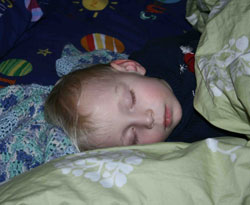
Because he’s 3, I’m not worried. And he’s not worried, which the experts say is the main thing parents need to watch out for: Be sensitive to the child’s feelings and don’t shame him for bed-wetting. So we keep our frustration to ourselves and try to be proactive by limiting liquids in the evening and waking him up to use the bathroom right before we go to bed. He’s perfectly willing to do this. And once – one happy, happy night – he actually woke me up to say he had to go potty.

But even though I won’t start to worry until he’s one of the 20 percent of kids who still wet the bed at age 5 (which drops to 13 percent at age 6 and 5 percent at age 10), I’m still looking for tips on ways to speed up his normal development out of enuresis (the medical term). One I haven’t tried yet but that may be promising is moving his bedtime up by half an hour, so he’s not quite so dead-to-the-world tired, and thus will be more likely to wake up when he feels the urge to go.

So browsing the Web at sites like WebMD has been a little reassuring. And I’ve heard from countless parents at work, at the gym and at school about how their child wet the bed forever until they used a bed-wetting alarm, medication, etc. Then there are those who’re convinced that potty training their child at like 17 months or something crazy early like that was the magic age, and that I’m done for because my son wasn’t fully out of diapers until 42 months. In fact, the “magic age” for starting potty training is between 24 and 32 months, according to a study published in the Journal of Pediatric Urology. Children who started then were less likely to have future bed-wetting and other problems. The key word, of course, is START – you can still have a kid wearing diapers for nearly a year, as ours was, and it's perfectly normal.

Share This Story

Amy De La Hunt is a journalist and editor who lives in the St. Louis metro area and works across the country as a writer, copy editor, project manager and editorial consultant on everything from fiction books to monthly magazines to blog posts. When she's not chauffeuring her teenage sons to activities, Amy is an enthusiastic amateur cook, landscaper, Latin dancer and traveler. Follow Amy on Instagram @amy_in_words


Our Daily Things to Do email is the easiest way to plan your day.
Follow Us
 
Things to Do

Music & Movement
Wednesday, March 11, 2026
Friday, March 13, 2026

Explore songs, finger plays, music and more during this Music & Movement class for ages 0-6. Some sessions are held in person at various branches of the St. Louis County Library. Some sessions are virtual. 


View this event »
Toddler Time at The Magic House

Visit The Magic House for Toddler Time, a special early-morning program for toddlers. Children age 1-4 can take part in exhibits and exclusive interactive activities designed just for little ones. There are new themes every week!


View this event »
Open Gym at Miss Kelly's Gym in Cottleville
Wednesday, March 11, 2026

Open Gym at Miss Kelly's Gym is an opportunity for any child to have supervised free play in the gym.  They can work on existing skills, try something new, or simply play around. It is completely up to them! Open Gym is open to both members and non-members ages 12 and under.


View this event »
Auditions for the St. Louis Children's Choirs
Wednesday, March 11, 2026
Wednesday, March 25, 2026
Saturday, April 18, 2026

Friendly and fun, auditions at The St. Louis Children’s Choirs are a great way for us to get to know one another. Auditions consist of your child singing a short song followed by a short informational meeting. A singer's ensemble placement is based on age, skill, maturity, and availability. The St. Louis Children's Choirs has an ensemble for every singer!


View this event »
Want daily ideas of things to do? How about special offers & giveaways? Sign up and we’ll handle the rest.
Popular Stories

10 Sweet Ways for Kids to Celebrate Valentine's Day

Feel the love and have lots of fun at these Valentine's Day-themed events just for kids and families.

Continue reading »
Spring Break Camps Offer a Variety of Activities for Kids and Teens in St. Louis

Excitement is building for summer and the wide variety of summer camp experiences available for kids in the St. Louis metro area. But first! Spring break is around the corner, and there are plenty of Spring Break camps enrolling now. 

Continue reading »
Single-Day Camps & Fun for Your Kids on President's Day

Are you looking for a fun way for your kids to spend President's Day while school is out? Here are some one-day camps and other fun activities to keep your kids busy, learning new skills, and having fun.

Continue reading »
Ninja Central is for Kids of All Ages and Abilities

From the moment they step onto a ninja training course, kids snap into activation mode – using their athletic skills to jump, climb, and balance their way through physical challenges and activating their minds to out-maneuver the puzzle of obstacles that stand in their way of victory. That combination is a powerful one and equips kids with the confidence, persistence, self-esteem, and creative thinking skills they need throughout their lives. And now, with the opening of Ninja Central, a top-tier ninja training facility in Maryland Heights, even more young athletes will get the chance to reach their full potential.

Continue reading »
Miriam Celebrates Neurodiversity, Supports Unique Learners

At Miriam School, students with complex learning differences are supported and celebrated as they grow academically, socially and emotionally. Miriam provides a tailored educational experience for learners in grades K-12 who have not found success in traditional classroom settings. Students’ challenges may stem from specific learning disabilities (i.e. dyslexia or dysgraphia), ADHD, level 1 autism, sensory processing disorder, anxiety, or speech and language disorders.

Continue reading »
You Might Also Like...

From Our Sponsors
Follow Us