







Yeee-ouch! Who Knew a Simple Bandage Could Be So Complicated?
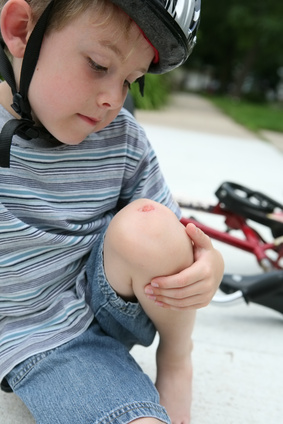 So yesterday my son was racing a neighbor kid toward a hammock and wound up skidding down the sidewalk on his elbows and hips. What started out as a pretty typical summertime bang-up led to a serious debate about the merits of various bandages.
It turns out that parents have strong beliefs about what’s in their medicine cabinets.
All of us have bandages. Many of us have antibiotic ointment. But within those simple categories are vastly different styles, strengths and active ingredients – and it turns out that some techniques are probably better at fighting off infections in everyday scrapes than others.
First, some definitions:
1. Antibiotic: An infection-fighting agent that comes in various forms, combinations and strengths. When you’re talking about an antibiotic you swallow, the term refers to a drug that fights off bacteria, but for external uses the definition is broader, sometimes including antifungal and antimicrobial products. In ointment form, an antibiotic also helps keep wounds moist.
2. Antibacterial: Any disinfecting agent that stops, slows or prevents the growth of bacteria. This term typically does NOT refer to medicine, but rather to products like soap or gel.
3. Antiseptic (or antimicrobial): Any substance that stops the growth or development of infection-causing microorganisms like – but not limited to − bacteria. Some of these (iodine tincture, which contains alcohol) hurt more than others (hydrogen peroxide, which works through oxygen bubbles) when used topically to clean injuries.
The best way to treat a minor cut, scrape or other kiddie boo-boo is to clean it with water and soap, then cover it with a bandage to keep it clean. (A little bleeding is a good thing because it can help get rid of dirt and germs too, but if you can’t stop the bleeding after 10 minutes of applying pressure, it’s off to the ER for you.)
Because most of our kids tearfully demand bandages, most parents tend to grant their wish regardless of the severity or location of the injury. It’s important to remember that a bandage applied to a dirty wound really doesn’t do much good – unless the wound is washed as soon as possible and you put on a new, clean bandage afterward.
However, when you are out and about with no way to wash the wound right away, putting on an antibiotic ointment and then a bandage may be do some good. It can reduce the risk of infection (and, let’s keep in mind, a slight infection of a small cut is really not a big deal either way). Most antibiotic ointments contain about the same formulation and ingredients – in comparing the four in my own medicine cabinet, I found the same primary ingredients in three of them, and the other shouldn’t really count anyway, as it’s only available by prescription.
The subtle variation in ointments was in the number of antibiotics – usually two or three – as well as the addition of a mild pain reliever. Neosporin, to give one example, has three antibiotics plus pain relief. It should be noted that some newer ointments contain stronger concentrations that could lead to allergic reactions or swelling in some people.
Some bandages come pre-loaded with antibiotics, which is certainly convenient on the go. However, if the wound is cleaned before the bandage is put on, the antibiotic is redundant. Not that two lines of protection are a bad thing …
Other bandages say their pads are antibacterial. This could mean various things, so it’s best to read the fine print to make sure you’re OK with what you’re buying. Some parents are looking to avoid antibacterial products in general, but these bandages may in fact contain the same antibiotics as the ointments rather than the agents in antibacterial soaps and gels.
Liquid bandages – often used on knees and elbows, where traditional bandages never seem to fit quite right – usually contain an antiseptic (different from the typical antibiotic ointments). If you’re using these, it’s still best to clean the wound first. Don’t apply antibiotic ointment first, because it could loosen the bond and make the liquid bandage less effective.
The silver nanoparticle bandages that appeared a few years ago are no longer widely available, and the jury seems to be still out on whether silver’s antibiotic properties are useful in wound treatment in clinical settings. The sticking point seems to be that the silver doesn’t promote bacterial growth but it may not stop it either, so in lab experiments it was sometimes found that nothing grew on the silver threads, but there was bacteria growing everywhere else.
You might also have seen hydrocolloid bandages. They contain a substance that forms a gel when it gets wet, and the gel helps keep the wound moist. Usually they do not have antibiotics in them (though simply by covering the injury they do help keep out bacteria, which is definitely beneficial). Because these bandages are designed to be changed every few days, they should only be used with sterile wounds, preferably on the advice of a doctor.
And then there are the debates over generics versus brand-names, waterproof versus flexible foam, transparent versus cartoon character, or round versus rectangular …
By Amy De La Hunt, Health Blogger for SmartParenting
Share This Story

Amy De La Hunt is a journalist and editor who lives in the St. Louis metro area and works across the country as a writer, copy editor, project manager and editorial consultant on everything from fiction books to monthly magazines to blog posts. When she's not chauffeuring her teenage sons to activities, Amy is an enthusiastic amateur cook, landscaper, Latin dancer and traveler. Follow Amy on Instagram @amy_in_words